

Fire Safe vs Security Safe: Which Do You Need?

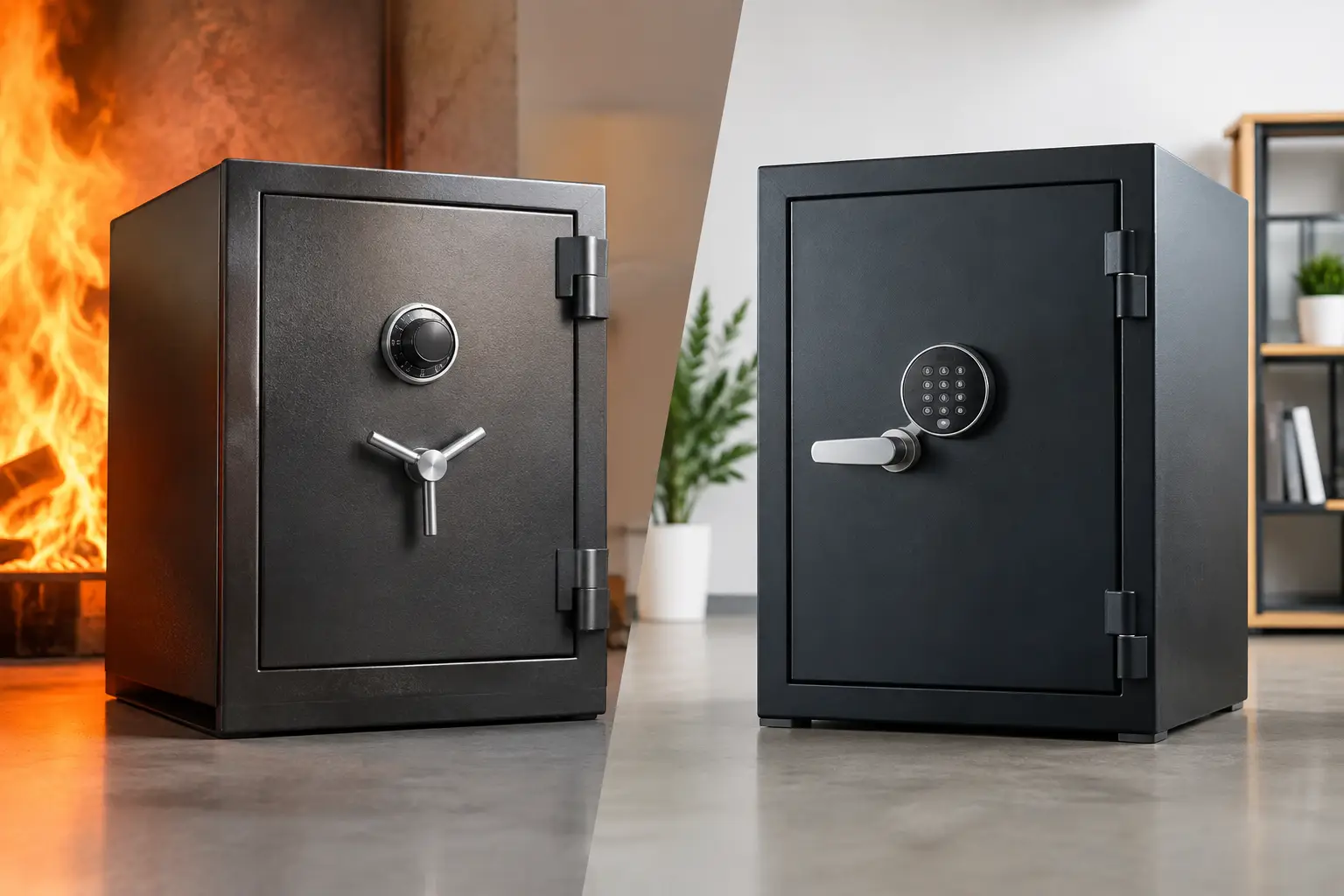
A passport that survives a break-in but turns to ash in a fire is not protected. Neither is a fire-rated document safe that can be carried out by one person. The fire safe vs security safe decision starts with a clear question: are you primarily defending valuables from heat and smoke, forced entry, or both?
For homeowners, the answer often involves passports, property records, cash, jewelry, and digital backups. For businesses, it may include daily cash, contracts, employee files, keys, inventory records, or high-value stock. Each risk requires different safe construction, testing, placement, and locking features.
Fire Safe vs Security Safe: The Core Difference
A fire safe is built to protect its contents from high temperatures for a stated period. Its insulation slows the transfer of heat into the storage compartment, helping keep paper documents, and sometimes digital media, below damaging temperatures. Fire resistance is the priority.
A security safe, also called a burglary-resistant safe, is built to delay or defeat unauthorized entry. Its protection comes from steel thickness, door construction, locking bolts, anti-pry design, drill resistance, relocking devices, and secure anchoring. Theft resistance is the priority.
These are not interchangeable categories. A basic fire safe may protect paperwork during a short fire but offer limited resistance to tools or physical removal. A basic security safe may withstand a determined theft attempt yet provide little verified protection for paper records during a fire. Some high-quality safes combine both capabilities, but buyers must confirm the rating for each risk rather than assuming one feature includes the other.
What a Fire Safe Protects
Fire safes are a practical choice when your greatest concern is the loss of vital records. A house fire, electrical fault, kitchen incident, or commercial building fire can destroy documents long before a building is fully damaged. A rated fire safe gives those items a controlled environment for a specified test duration.
When comparing models, look beyond the word “fireproof.” No safe is completely unaffected by every fire scenario. Instead, review the stated fire rating, the test standard behind it, the temperature exposure, and the internal temperature limit. A 30-minute rating may suit basic home records, while a 60- or 120-minute rating can be more appropriate for important office files, legal documents, and business continuity records.
The item stored matters as much as the duration. Paper documents can tolerate more heat than USB drives, external hard drives, memory cards, and other digital media. If digital media is essential, choose a safe specifically rated for that purpose. A document fire rating alone may not keep electronic storage devices within safe temperature and humidity limits.
Fire protection also depends on installation. A safe placed near fuel sources, in a poorly accessible area, or directly on a floor vulnerable to water damage needs additional planning. Firefighting water and sprinkler discharge can harm documents and electronics after the flames are controlled. Waterproof seals can be useful, but they should not replace a proper fire rating or sensible document backup procedures.
What a Security Safe Protects
Security safes are designed for situations where theft, tampering, and forced entry are the leading concerns. They are commonly used for jewelry, cash, watches, firearms where legally permitted, keys, sensitive files, retail takings, and other valuables that attract opportunistic or targeted theft.
The level of security should match the value of what you store and the likely threat. A compact home safe secured inside a wardrobe may be adequate for modest valuables when it is correctly anchored. A jeweler, retail operation, finance office, or business holding significant cash requires a much stronger solution, often with certified burglary resistance, a heavier body, advanced lock protection, and professional installation.
Weight is useful, but it is not a complete measure of security. A heavy safe can still have weak boltwork, poor lock protection, or no verified burglary rating. Review the door design, wall thickness, bolt coverage, lock type, and certification where available. For higher-risk locations, ask whether the safe includes anti-drill plates, glass relockers, hardplate protection, and defenses against prying or cutting tools.
Anchoring is essential. Even a well-built security safe becomes vulnerable if thieves can remove it and work on it elsewhere. A suitable model should be fixed to a structurally sound floor or wall according to the manufacturer’s requirements. Professional delivery and installation are particularly valuable for heavy commercial safes and units installed in upper-floor offices or retail premises.
When You Need Both Fire and Theft Protection
Many buyers do not have a single risk. A family may need to protect passports and title documents from fire while also securing jewelry and cash from theft. An office may store contracts that must survive a fire, alongside access keys, petty cash, and confidential records that must not be removed.
In these cases, a dual-purpose safe is often the right investment. It should have separately stated fire and burglary performance, not simply a marketing label that suggests general protection. Confirm the safe’s fire duration, intended content type, locking arrangement, burglary construction, and anchor points before ordering.
Another option is to use two dedicated units. A fire-rated filing cabinet can protect large volumes of paper records, while a burglary-resistant safe protects cash, keys, and valuables. This arrangement can be more practical for administrative departments with active files and separate high-value items. It also reduces the risk of overloading one safe with incompatible storage needs.
How to Choose the Right Safe
Start by listing what will be stored, its replacement cost, and the impact of losing it. A passport may have a modest financial value but can cause major disruption. A signed contract, client file, jewelry collection, daily cash float, or master key set may create much greater operational exposure.
Then assess the location and threat level. A home with regular occupancy has different risks from an unattended warehouse, hotel back office, jewelry store, or retail cash room. Consider who has access, whether the safe will be visible, how long the property may be empty, and whether cash is held overnight.
Use these five buying checks before selecting a model:
- Match the fire rating to the time protection you need and the type of contents you will store.
- Match burglary resistance to the value at risk and the likelihood of a targeted attack.
- Measure the internal capacity, not only the exterior dimensions, especially for files, binders, cash boxes, or jewelry trays.
- Select the lock format your team can manage, whether key, electronic keypad, combination, biometric, or dual control.
- Confirm the installation surface, delivery access, safe weight, and anchoring plan before purchase.
For commercial use, access control deserves particular attention. A single key may be simple, but it can be difficult to control across shifts. Electronic locks can support user codes, time delay, audit features, or dual authorization depending on the model. A deposit safe may be better suited to retail cash drops because it allows staff to deposit funds without opening the main secure compartment.
Common Buying Mistakes to Avoid
The most common mistake is choosing by price alone. A low-cost safe may be appropriate for light-duty storage, but it should not be expected to protect high-value jewelry, substantial cash, or critical company records. Under-specifying a safe can leave a business exposed and may create insurance issues.
Another mistake is buying a fire-rated safe for valuables that are mainly at risk of theft. Fire protection does not automatically mean burglary protection. The reverse is equally true: a strong steel safe without a confirmed fire rating may not protect records after prolonged heat exposure.
Buyers also underestimate capacity. Safes fill quickly when documents are placed in folders, cash is kept in containers, or valuables need separated storage. Allow room for future records, trays, shelves, and access without stacking items against the door. Finally, do not treat a safe as a substitute for good procedures. Limit code access, change credentials when staff leave, keep contents confidential, and maintain secure backups of essential records.
Protect What Matters Most by selecting the safe for the loss you cannot afford. Safe World UAE can help homeowners and businesses compare fire-rated, burglary-resistant, deposit, jewelry, and filing solutions so protection supports daily operations as well as long-term security. Contact Us to match the right safe to your assets, premises, and access requirements.