

Safe Installation Requirements for Secure Protection

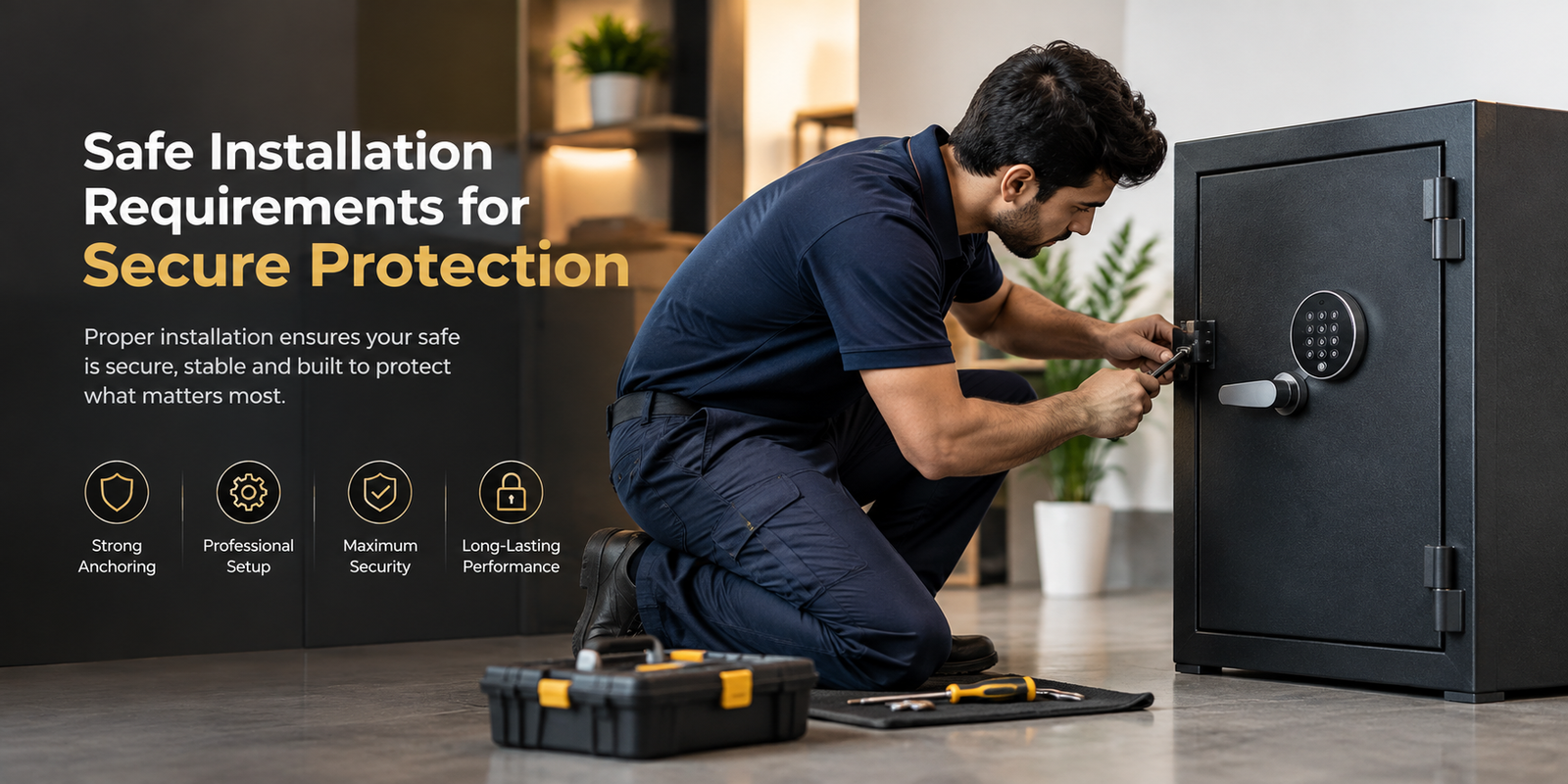
A security safe only performs as intended when it is installed in the right location and fixed correctly. Safe installation requirements affect more than convenience: they determine whether a safe resists removal, protects its fire rating, remains accessible during an emergency, and operates reliably for years.
For a home safe holding passports and jewelry, a poorly chosen location can make the unit easy to target or difficult to open. For a retail, office, or jewelry operation, incorrect installation can create cash-handling risks, disrupt daily access, and expose the business to avoidable loss. Start with the safe’s specifications, the building conditions, and the assets you need to protect.
Start With the Safe’s Purpose and Rating
Installation decisions should follow the security requirement, not the other way around. A compact home safe for documents has different mounting needs than a burglary-resistant jewelry safe, a deposit safe, or a large fire-resistant filing cabinet.
First, confirm what the safe is designed to protect. Fire-resistant safes are rated to protect paper documents, while media safes are designed for more sensitive items such as digital storage. Burglary-resistant safes focus on delaying forced entry and should normally be anchored where the manufacturer permits it. Deposit safes need a practical location that supports secure cash drops without exposing staff or customers.
Check the product’s weight, outside dimensions, door swing, anchoring points, and recommended installation method before delivery. A safe can look compact in a product image but become difficult to position once its door clearance, handle projection, and anchoring space are considered. This is especially relevant for premium safes, large-capacity models, and fire-resistant filing systems.
Choose a Location That Balances Security and Access
The best position is rarely the most obvious one. A safe should be available to authorized users without being visible, isolated, or easy to remove. For many homes, a discreet ground-floor location away from exterior doors and main windows offers a practical balance. Avoid placing the unit in an area that is regularly exposed to moisture, direct heat, flooding, or severe temperature changes.
In a business, think through the actual workflow. A cashier may need a deposit safe near the point of transaction, while a finance department may need a higher-security safe in a controlled back-office area. Jewelry safes and vault doors require restricted access, strong structural support, and a clear process for who holds keys, codes, or dual-control credentials.
Do not install a safe where the door cannot open fully. Measure the opening arc and ensure there is room for users to stand, retrieve contents, and service the lock. Shelving, desks, filing cabinets, and stock can gradually block a safe that initially appeared accessible. Leave adequate clearance from the start.
Consider Privacy Without Creating Isolation
A concealed safe location can reduce casual visibility, but the area must still be safe to use. Avoid cramped spaces where the door could trap a user or where lighting is too poor to operate an electronic keypad. If the safe is used by several employees, choose a controlled location that can be monitored without making the safe publicly visible.
For hotels and hospitality properties, in-room safes should be installed where guests can access them comfortably while housekeeping and maintenance teams can inspect or replace batteries when required. Consistent placement also makes training and guest support easier.
Verify Floor Strength and Structural Support
A loaded safe can place substantial weight on a small area. This matters most with large fire-rated safes, burglary-resistant models, filing cabinets, and commercial units holding cash, records, or inventory. The floor must safely support the combined weight of the safe and its maximum contents.
Concrete floors are generally preferred for floor-mounted safes because they provide a stable base for approved anchor bolts. Upper floors, raised floors, tiled surfaces, wood flooring, and suspended slabs may require additional assessment. Never assume that a finished surface indicates the strength of the structure beneath it.
If a safe is being placed on a finished floor, consider both protection and stability. Thin leveling materials may help correct a minor uneven surface, but they should not substitute for proper structural support or interfere with anchoring. A safe that rocks, tilts, or sits on an uneven base can place stress on its body, door, and locking mechanism.
Wall safes require equal caution. They must be fitted into a suitable structural wall, not simply a lightweight partition. The wall construction, cavity depth, reinforcement, and surrounding utilities all need checking before any opening is made. A wall safe can be highly discreet, but it typically offers less capacity and may have different fire and burglary performance than a freestanding model.
Anchoring Is a Core Safe Installation Requirement
Anchoring prevents a thief from carrying the entire safe away to attack elsewhere. It also helps stabilize the unit during normal use, particularly when a heavy door is opened. Where a safe includes factory anchor holes and the manufacturer approves anchoring, use the specified fixing method and suitable anchors for the surface.
Do not drill new holes into a safe body unless the manufacturer explicitly authorizes it. Unapproved drilling can damage fire insulation, reduce security performance, affect the warranty, or interfere with internal locking components. This is particularly critical for fire-resistant safes, where the construction is designed to protect the interior under extreme heat.
Proper anchoring depends on the substrate. Concrete, solid masonry, steel structures, and timber construction each require different hardware and installation methods. The anchor must be matched to the safe weight, the expected force, and the base material. A bolt that is suitable for a lightweight cabinet may be inadequate for a burglary-resistant safe.
For high-value installations, professional fitting is the sensible choice. A trained installer can confirm the surface, use the correct equipment, position the safe accurately, and complete the work without damaging the lock, finish, or surrounding property. Safe World UAE can assist customers in Abu Dhabi and Dubai with selecting a suitable model and planning the installation around the site conditions.
Plan Delivery Before the Safe Arrives
Installation begins at the delivery route. Measure entry doors, corridors, elevators, stairways, turns, and the final room before ordering. Include the safe’s packaged dimensions, not only the unit dimensions, because protective packaging can add significant width and depth.
Heavy safes may require specialist moving equipment, additional personnel, or a scheduled delivery window. Never attempt to drag a heavy safe across tile, hardwood, or raised flooring. This can damage the building and create serious injury risk. The route should be clear of loose rugs, cables, furniture, and obstructions before the delivery team arrives.
For commercial sites, coordinate with facility management in advance. Building access rules, loading bays, elevator weight limits, working hours, and permit requirements can affect the installation schedule. Planning this early avoids last-minute handling risks and business disruption.
Protect Lock Access and Daily Operation
Mechanical key locks, combination locks, electronic keypads, biometric systems, and dual-lock configurations each need an operating plan. Keep emergency keys, override credentials, and lock instructions separate from the safe itself. Restrict access to authorized people and document who is responsible for code changes, battery replacement, and key control.
Electronic locks need periodic battery checks. Install the safe where the keypad can be seen clearly and where users can access an external emergency power contact if the lock design includes one. Avoid placing furniture directly against the keypad area or door edge.
After installation, test the safe several times with the door open before loading valuables. Confirm that the boltwork extends and retracts smoothly, the door closes without rubbing, the lock accepts the code, and any time-delay or audit features work as expected. Then confirm that the safe remains level and stable after the door is fully opened.
Complete a Final Security Check
Before placing cash, records, jewelry, or confidential material inside, inspect the completed installation. The safe should sit firmly on its base, approved anchors should be fully secured, and the door should open without striking a wall or cabinet. The location should be dry, reasonably private, and accessible only to the right people.
For offices, add the safe to your operational procedures. Define who can deposit funds, who can open the safe, how keys and codes are controlled, and what happens when an authorized employee leaves. For homes, make sure trusted family members understand emergency access without broadly sharing the code.
A safe is a long-term security investment, not a box to place in an empty corner. Choose the right unit, prepare the structure, anchor it correctly, and verify its operation before it protects what matters most. When the installation is treated with the same care as the safe itself, your valuables are far better protected.