

Mobile Shelving for Office Files That Works

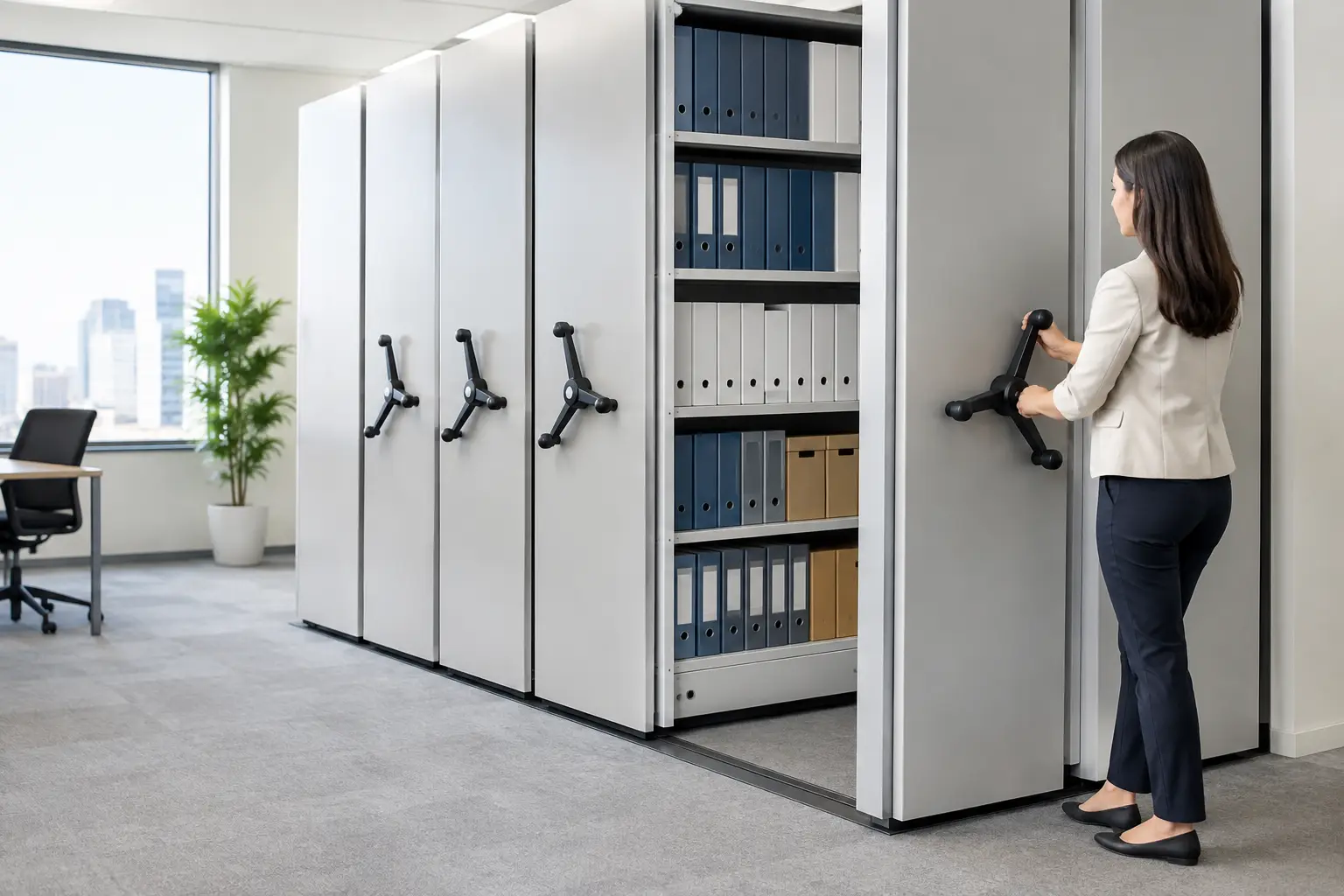
A records room can look organized and still waste a large part of its floor area. Fixed filing cabinets and open shelving create permanent access aisles between every row, leaving space that stores no documents at all. Mobile shelving for office files changes that layout by placing shelving units on guided tracks, so one aisle opens only where staff need it.
For offices managing contracts, HR files, accounting records, case folders, drawings, or archived correspondence, this can significantly increase storage capacity without expanding the room. The right system also improves retrieval discipline, protects files from avoidable damage, and gives facility teams better control over a growing records archive.
What Mobile Shelving for Office Files Does
Mobile shelving is a high-density storage system made of shelving bays mounted on a mobile carriage. Instead of walking through several fixed aisles, the user turns a hand wheel, uses a mechanical-assist control, or operates an electric control to move an entire row and create a working aisle.
The practical benefit is simple: one active aisle can serve many shelving rows. In a room with fixed shelving, each row requires its own aisle. With a mobile system, the same floor area can accommodate substantially more filing capacity, depending on the shelving dimensions, room shape, and required access space.
This makes mobile shelving particularly suitable for administrative departments where physical records remain necessary but office floor space is expensive. It is commonly used in finance departments, legal offices, government archives, healthcare administration, educational institutions, and corporate records rooms.
Mobile shelving is not the same as a standard filing cabinet on wheels. It is a planned storage installation that requires a suitable floor, correctly positioned tracks, specified load capacity, and safe operating clearance.
Start With Records, Not Shelf Measurements
The first question is not how many shelving bays will fit in the room. It is what must be stored, how often it is accessed, and how long it must be retained.
Active files that employees retrieve throughout the day need fast access, clear labeling, and a layout that avoids waiting. Archived records may be accessed only occasionally, making them a stronger candidate for dense mobile storage. Many offices use both approaches: open-access filing close to workstations and mobile shelving in a dedicated records area.
Before selecting a system, separate your records into practical groups. Consider file type, folder size, retention period, confidentiality level, and retrieval frequency. Boxed archives need different shelf depths and clear heights than lateral files, lever-arch binders, or hanging folders. A system planned around the wrong format can create wasted vertical space or unstable stacks.
Also allow for growth. Filling every shelf on installation day may seem efficient, but it makes re-filing difficult and leaves no capacity for annual records. A reasonable expansion allowance helps the system remain useful rather than becoming another crowded archive within a short time.
Measure the Room and Check the Floor
A mobile shelving system concentrates a considerable load in a smaller footprint. The floor must support the combined weight of the carriages, shelving, files, and users operating the system. This is especially relevant in upper-floor offices, older buildings, and rooms with raised access floors.
Accurate site measurements should include room length and width, ceiling height, door swing, columns, windows, electrical panels, sprinklers, HVAC equipment, and emergency routes. Doors must open fully, and staff must be able to access fire equipment and building services without moving shelving units.
Floor level is equally important. Tracks need a stable, properly prepared base so carriages move smoothly and shelving remains aligned. A site assessment can identify whether the existing floor is suitable, whether leveling work is required, or whether a raised platform is the better installation method.
Do not assume that a compact room automatically needs a compact system. A narrow room with poor door placement or a low ceiling may have fewer usable layout options than a larger records area. The best configuration balances storage density with safe, practical file retrieval.
Choose the Right Operating Method
Manual mobile shelving is operated by pushing the carriage or using a hand wheel. It is often a practical choice for smaller archives, lighter file loads, and rooms with moderate daily access. It keeps the system straightforward and can be cost-effective when staff do not need to open multiple aisles constantly.
Mechanical-assist systems use a geared wheel or similar mechanism to move heavier rows with less effort. They suit medium-to-large records rooms where shelving loads are higher but the system does not require electronic controls.
Electric mobile shelving is designed for larger installations, frequent access, or organizations that want enhanced control features. Depending on the model, controls may include aisle selection, safety sensors, access restrictions, and system status indicators. It can improve convenience, but it also requires power planning, appropriate maintenance, and staff familiarization.
There is no single correct option. A lightly used archive may not justify an electric system, while a busy central filing room can lose time and create frustration if a large manual system is difficult to move. Select the operating method based on file volume, row length, load, and daily retrieval patterns.
Build Safety Into the Layout
A high-density filing system should make access safer, not merely tighter. Mobile shelving needs anti-tip design, stable guide tracks, and controls that prevent uncontrolled carriage movement. Shelves should be rated for the intended load and fitted with appropriate dividers, back panels, and file supports where needed.
For electrically operated systems, aisle safety protection is essential. Sensors and safety features should stop movement when a person or object is detected in the aisle. Emergency-stop functions, clear operating instructions, and controlled access are also valuable in shared records rooms.
Training matters even with manual units. Staff should know how to open an aisle, check that it is clear, close it correctly, and avoid overloading shelves. Keep heavy archive boxes on lower levels and distribute weight evenly across bays. Poor loading can reduce stability and make daily use harder.
Confidentiality is another safety consideration. Mobile shelving organizes files efficiently, but it does not automatically provide fire protection or document-level security. Sensitive records may require lockable shelving, restricted room access, or secure filing compartments. Records that need tested fire resistance should be stored in a fire-resistant filing cabinet selected for the required protection level, rather than relying on standard shelving alone.
Make Retrieval Fast and Consistent
High-capacity storage only helps when employees can find records without opening several aisles and searching every shelf. Use a clear indexing plan before files enter the system. Department, year, client number, case reference, document category, and retention status are common filing identifiers.
Label each mobile carriage, shelving bay, shelf level, and file range in a consistent format. Large, readable labels reduce misfiling and help temporary staff follow the same process. A simple file-out guide or sign-out procedure is useful for records that move between departments.
Avoid storing unrelated materials in the same system simply because space is available. Files, stationery stock, old equipment, and personal items require different organization methods. Keeping the mobile shelving dedicated to a defined records function preserves its capacity and makes audits easier.
For organizations moving from filing cabinets to a central archive, plan the transfer in stages. Audit existing files, remove records approved for disposal, verify retention obligations, label folders, and then load shelves according to the new location plan. Moving clutter into a better storage system does not solve the underlying filing problem.
Plan for Installation and Long-Term Use
Mobile shelving is an infrastructure purchase, not an item to place casually against a wall. Installation should account for floor preparation, track alignment, anchoring where required, aisle clearance, load distribution, and testing before the archive is put into service.
After installation, inspect the system regularly. Look for track obstructions, loose labels, damaged shelves, uneven loads, and signs that carriages are no longer moving freely. Keep tracks clean and follow the supplier’s maintenance guidance, especially for mechanically assisted or electric systems.
For offices in Abu Dhabi and Dubai, a site-based review is particularly useful when records rooms are being fitted into existing commercial space. It helps confirm that the proposed storage capacity works with the building conditions and the way employees actually retrieve files.
Safe World UAE can support offices that need mobile shelving alongside filing systems, metal cupboards, fire-resistant filing cabinets, and other workplace storage equipment. A coordinated approach helps procurement teams protect sensitive records while keeping everyday administration efficient.
The most effective records room is not the one with the most shelves. It is the one where every file has a secure location, every aisle can be used safely, and staff can retrieve what they need without losing time. Plan the system around that standard, then order the capacity that supports it.